Alexandria welcomes you.

Mexico City, Mexico

A little room.
A little care.

I can learn from a grower, try a planting, and show what I changed.

Words for your journey

Begin with hello.

Listen to these Spanish words, then try one with someone beside you.

Spanish · Mexico

Hola

Hello

Spanish · Mexico

Gracias

Thank you

Spanish · Mexico

Por favor

Please

Spanish · Mexico

Hasta luego

See you later

Ximena’s seedlings · Mexico City

A little room
to grow.

In our book, Ximena takes Abuela’s seedlings to the chinampa. Alexandria asks Abuela to show her how to plant them.

Choose a seedling above.
Touch a place in the soil.

Pick up a seedling. Where will you put it?

The bed is empty. Three seedlings are on the tray.

Move with buttons

Pick up a seedling. Move it, then set it down.

Someone to learn from.

Keep this planting while you look at how a grower works. Then choose something to try differently.

Felipe Barrera · Xochimilco

Care learned together.

Look at how Felipe works among his plants. What would you like to ask someone who grows plants?

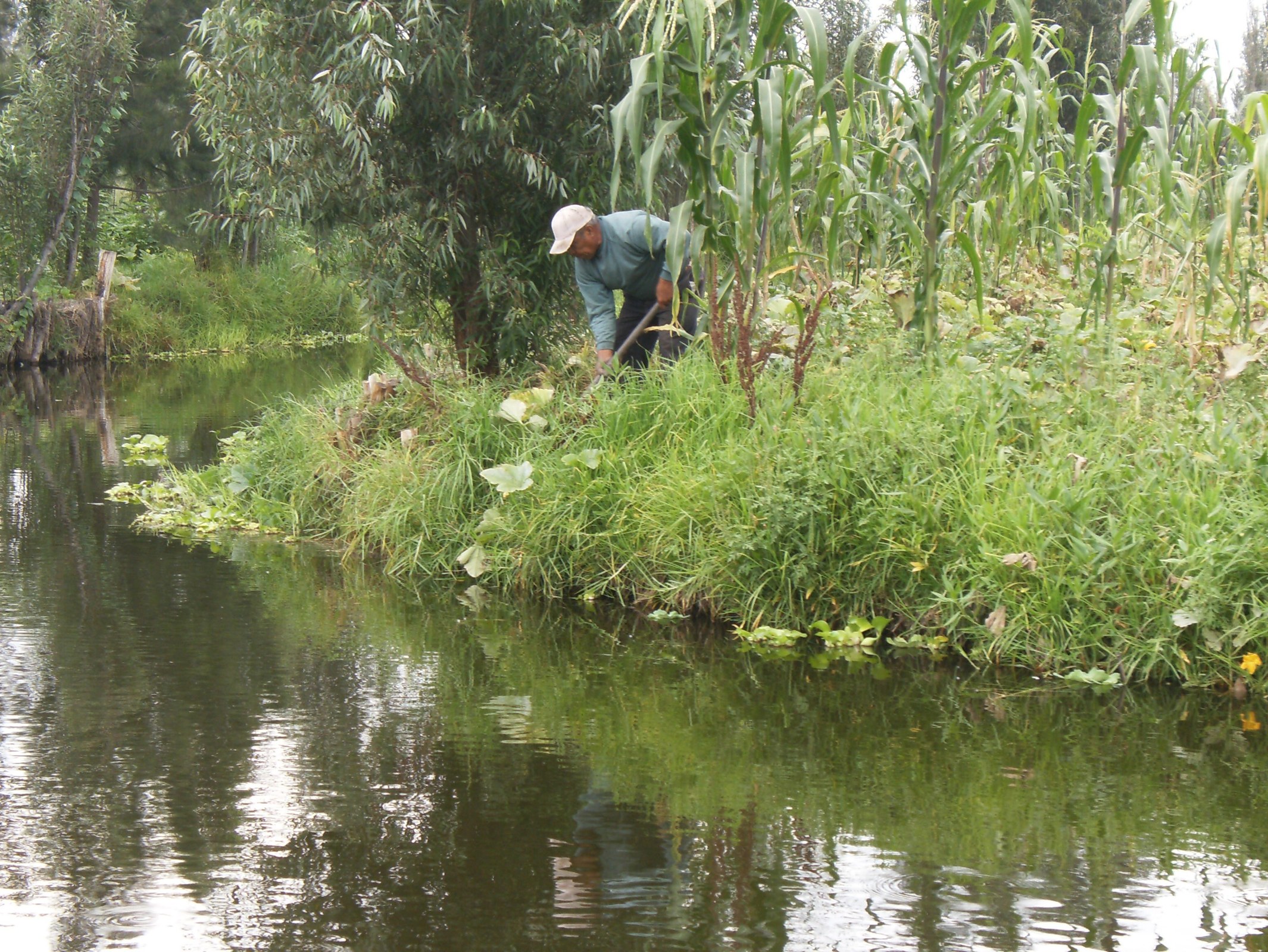
A grower tending a cultivated chinampa beside a canal.

21 seconds from UNAM. Spanish audio; read the English account below.

Read or hear it together

Felipe Barrera grows food on a chinampa in Xochimilco. His parents and grandparents shared their knowledge with him. A chinampa is a planted bed of land among canals. It stays in place.

Look at the plants and the spaces between them. Their care depends on what is growing. A grower can show you what a particular plant needs.

Go back to your planting. Pick up a seedling and try another place, or keep your arrangement. Show what helped you decide.

Show what you changed.

Point to a place you chose. Tell or show a partner what helped you decide. Would you move anything, or keep it where it is?

Carry it into your world

Ask. Watch. Try with care.

With a trusted person, find a plant you are allowed to care for. Ask them to show you one small care action. Watch their hands, then try with their help.

Tell or point to what you changed after watching. Let your partner share what they notice. Keep your choice, or try it another way.

No plant nearby? Take turns arranging three small objects on a table. Show how you left room to reach each one. A gesture, a description or watching a partner can be your way in.

Your world keeps growing

A little more of Mexico City.

Carry one thing you learned into a small act of care.

Mexico City, together

Allow about 15–25 minutes, or explore a little at a time. Begin with a place, a greeting or the planting. Nothing is timed or scored. The map and place buttons remain available if a film cannot play.

A planting to make, explain and revise

Invite a child to place one, two or three seedlings and keep that first arrangement. Watch the named grower or read the equivalent together. Invite a change and a comparison. Ask: What did watching help you notice? What would you ask a grower before planting for real?

The digital bed is an arrangement to think with, not a horticultural model or planting recipe. It does not predict growth, judge a correct distance or teach one depth for every species. The real transfer is learning one care action from a trusted person for a particular plant. Use safe, clean materials with an adult. No child handles canal water or visits a farm alone.

For a shared display, one child places while a partner points or describes. Take turns and let children observe or pass. The five-part Process Loop is made concrete here through the planting, explanation, reflection, a self-check and an everyday care action. Historical thinking, the C3 Inquiry Arc, Cortés’s bridgebuilding and cultural humility guide adult questions; this activity does not certify mastery. Read the framework guide.

Family story, place and culture

Ximena and Abuela’s seedlings are a fictional family story, from pages 4, 12 and 13 of the Mexico City book. Felipe Barrera is a real grower speaking in a separately credited source. Neither family represents everyone in Mexico City.

Chinampas are fixed raised growing beds among canals, not floating rafts. The FAO description of the chinampas agricultural system explains its land, water and living knowledge. UNESCO’s Historic Centre and Xochimilco record provides historical context.

Ask who made a source, where and when. Compare a photograph with a grower’s account without treating one child’s experience as a mistake. Cultural humility is a continuing practice of listening and revising. This lesson does not ask children to imitate sacred practices or perform an identity.

Film and language

Chinamperos y UNAM unidos por la supervivencia del ajolote, UNAM Global, 27 June 2024. The original player is embedded at 00:02–00:23.4. The excerpt introduces Felipe’s family knowledge; it is not a planting instruction. Spanish automatic captions belong to the publisher’s platform and may be unavailable. The English read-together account is an editorial paraphrase, not a verbatim translation. The lesson does not host a downloaded copy. UNAM’s accompanying report identifies Felipe Barrera and his family learning.

Spanish words use the es-MX-DaliaNeural pronunciation model. They are ordinary greetings, not a local character’s voice or a claim to represent every Mexican accent. The words remain visible when sound is unavailable.

Photographs, travel and source credits

The Zócalo is a real horizontal 360-degree photograph taken in 2007, displayed as a cylindrical strip. Look left or right. It has no captured view above or below. The other four stops are real photographs. Whole photo reveals their complete framing.

The short people-free Metro transition is an imagined travel scene, not a recording of a measured route or current service. Canal arrivals use an authentic still photograph. City features were checked against photographs before production.

Place research: INAH Templo Mayor; SEDEMA on Anfibium and axolotl conservation.

Metro research: Sistema de Transporte Colectivo iconography. Map data: OpenStreetMap contributors, Open Database License; display: Leaflet. These stops are an exploration, not a suggested travel itinerary.

Your planting and visit stamp stay in this browser. This lesson asks for no name, uploads no planting and records no voice. Clearing site data removes saved work. Playing the embedded film contacts YouTube, whose player has its own controls and policies.

Start a new planting?

Your seedlings will go back to the tray.

A real view of Mexico City

Our Mexico City places

A square, an ancient city, a conservation place and the canals. Choose a stop to travel there.