Alexandria welcomes you.

Rome, Italy

What our hands
can pass on.

I can try a hand motion, change what I make, and show someone my way.

Italian in Giulia’s story

A few words
to share.

Listen, turn a card and try a word with someone beside you.

Italian

Ciao!

Hello! / Bye!

A friendly greeting to Giulia.

Italian

Buongiorno.

Good morning.

Giulia greets the baker.

Italian

Grazie.

Thank you.

Alexandria thanks Nonna.

Italian

Andiamo!

Let’s go!

An invitation to go together.

Watch a maker’s hands

From a sheet
to ribbons.

Watch Mena prepare and cut the dough while Marie Luisa helps. Notice a motion you could try in our dough play.

An 18-second moment. You can watch, pause, or explore the description below.

The sounds and pictures

Mena spreads flour over a thin sheet of dough on a wooden board. She folds the sheet and cuts across it with a knife. The cut pieces open into long ribbons. Marie Luisa is nearby and helps separate them. Their hands work carefully. You can notice the changing shape without using real food or tools.

An English narrator describes adding flour to prevent sticking, then rolling the sheet and cutting it into slices. The makers also speak briefly in Italian, with light background music. This is an adult demonstration. In our play, a tap makes a cut.

Giulia’s family · Pages 11–13

What our hands
can pass on.

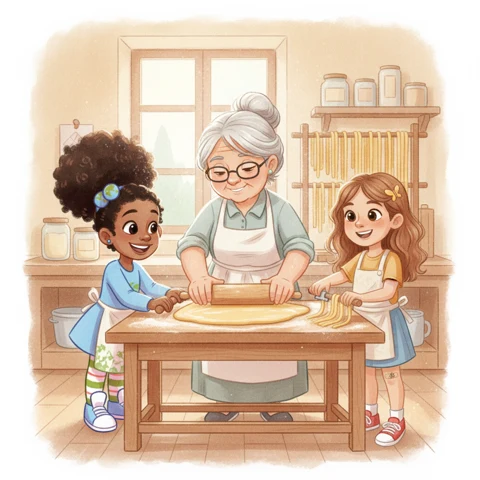
Nonna shows Alexandria how to roll and cut dough. Try the motion. Make your own ribbons.

Move across the dough to roll it. The buttons work too.

Roll the dough

A small piece of dough. What will your hands change?

This is dough play. There is no right ribbon width.

Show someone your way.

Show a motion you tried. Let your partner say what they notice before you tell your idea. Keep your ribbons, or lay them down and change a cut.

In the book, Nonna helps Alexandria roll dough while Giulia lifts pasta ribbons.
“My nonna taught my hands. Now my hands teach yours.”
Giulia’s family, in our Rome story, page 11.

Try it together

A motion worth
passing on.

Ask someone you know to show you one safe thing their hands can do. Perhaps they fold a cloth, roll a shape or turn a page gently.

Watch, then try. What changed? Ask for help or try another way. You can point or watch, too.

Now show your way to someone else. Let them try it. What would you keep or change next time?

Your passport

We’ve been to Rome.

Nonna passes on something her hands know.
What will you share?

Explore together.

Begin with our Rome book, pages 11–13. This experience suits a shared family or classroom screen. A child can tap, use a keyboard, point for a partner or watch. The book’s Nonna and Giulia are fictional people; their family is one story, not a description of every Roman family.

Gather

Allow about 10–15 minutes to explore and make, with another 5 minutes to show a partner. No ingredients or kitchen tools are needed. Read Nonna’s taught-hand moment, then try one rolling action.

Guide

The child controls how far the dough spreads and where each cut goes. Lift keeps the chosen ribbon widths. Invite a partner to notice before the maker explains. Lay them down, remove a cut or undo. Different ribbon widths are welcome. This is a simplified material play surface, not a recipe, accurate dough physics or an assessment of cooking skill.

Notice

The ribbons are the performance artifact. Ask the maker to show one motion and its effect. Listen to the partner’s reading. Invite one revision or a reason to keep a choice. Reflection and self-assessment happen through pointing, gesture or conversation, with no written response needed.

Carry it into the room

Invite someone the child knows to demonstrate one safe hand motion they use: folding a cloth, rolling allowed play material or turning a page carefully. The child tries it, describes what changed and teaches a partner. Ask whether anything would help next time. If a family chooses real food, the adult manages hygiene, ingredients, allergies, heat and tools. No child uses a knife as a lesson requirement.

How children learn here

The child makes, explains and revises something that another person can see. Merrill’s First Principles connect a whole task, demonstration, application and integration; here the source maker and book prepare a child’s own experiment, then a small transfer with a partner. This is an age-appropriate design application, not evidence that this particular lesson improves learning.

M. David Merrill: First Principles of Instruction. Tervalon and Murray-García: cultural humility describes ongoing self-reflection, power and accountable relationships in medical education. Our educational adaptation keeps one family’s story distinct from an entire culture and leaves room to learn from people with relevant knowledge.

History, evidence and perspective

Compare the fictional book scene with a maker’s filmed hands and a dated city photograph. Who made each source? What can we observe, and what are we inferring? Whose view could add to it? Children do not need to disclose private family stories.

Rome’s public fountains, cared-for places and taught practices offer different forms of continuity. They did not all begin at the same time. A dated photograph shows a particular view, not today’s access or the whole city. The Trastevere map point identifies the neighborhood; the photograph’s exact fountain location is not established.

City photographs and sources

The five stops are real still photographs, not 360° recordings. Each was resized and compressed; the whole-photo view preserves its composition. Photo versions retain the original licenses.

CC BY-SA 4.0 · CC BY-SA 3.0 · CC BY 3.0.

City sources, checked 17 September 2026: Roma Capitale: nasoni, Piazza Navona, Gianicolo, Trevi Fountain, Villa Borghese.

Travel and maps

The two five-second bus-window transitions are imagined views. They do not establish a literal route between the stops or current service. Their ordinary materials and streetscape were informed by ATAC’s own bus images and real city photographs. ATAC’s current travel information helps an adult plan an actual visit.

Map data: OpenStreetMap contributors, ODbL. Display: Leaflet. Stops are a learning collection, not a route recommendation.

Film source

Pasta Grannies: How to Make Fettuccine Pasta with Artichokes, 9 November 2017. The publisher identifies Marie Luisa and Mena and connects their fettuccine dish with Rome. The selected 18 seconds, 00:48–01:06, show preparation and cutting of the ribbons. This film does not establish the exact location of the kitchen or a practice followed by every Roman family.

We use the publisher’s original YouTube player, not a downloaded copy. The player supplies automatic captions and its branding. Its English captions mis-transcribe some Italian conversation. The picture guide and description explain the observed actions; they are not a verbatim translation. Source research is not that approval.

Words and listening

Treccani’s greeting guidance distinguishes familiar ciao from buongiorno. Grazie expresses thanks. Andare includes the invitation andiamo, “let’s go.” The four short audio models use Andromeda, an Italian-language voice. They say the displayed words; they are not Giulia’s voice or a local person’s testimony.

Using this page

Dough choices and the passport stay in this browser when storage is available. No child name, voice, photograph or account is collected. New dough resets the current artifact; Undo can restore it during this visit. If storage is unavailable, the activity still works for this visit. The embedded film and map contact their providers; neither is needed to finish the making activity.

Start with new dough?

You can show your ribbons together first.

A real view of Rome

Our Rome places

Five places in the city. Choose a stop to travel there.

The Trastevere pin marks the neighborhood. These stops are not a travel itinerary.