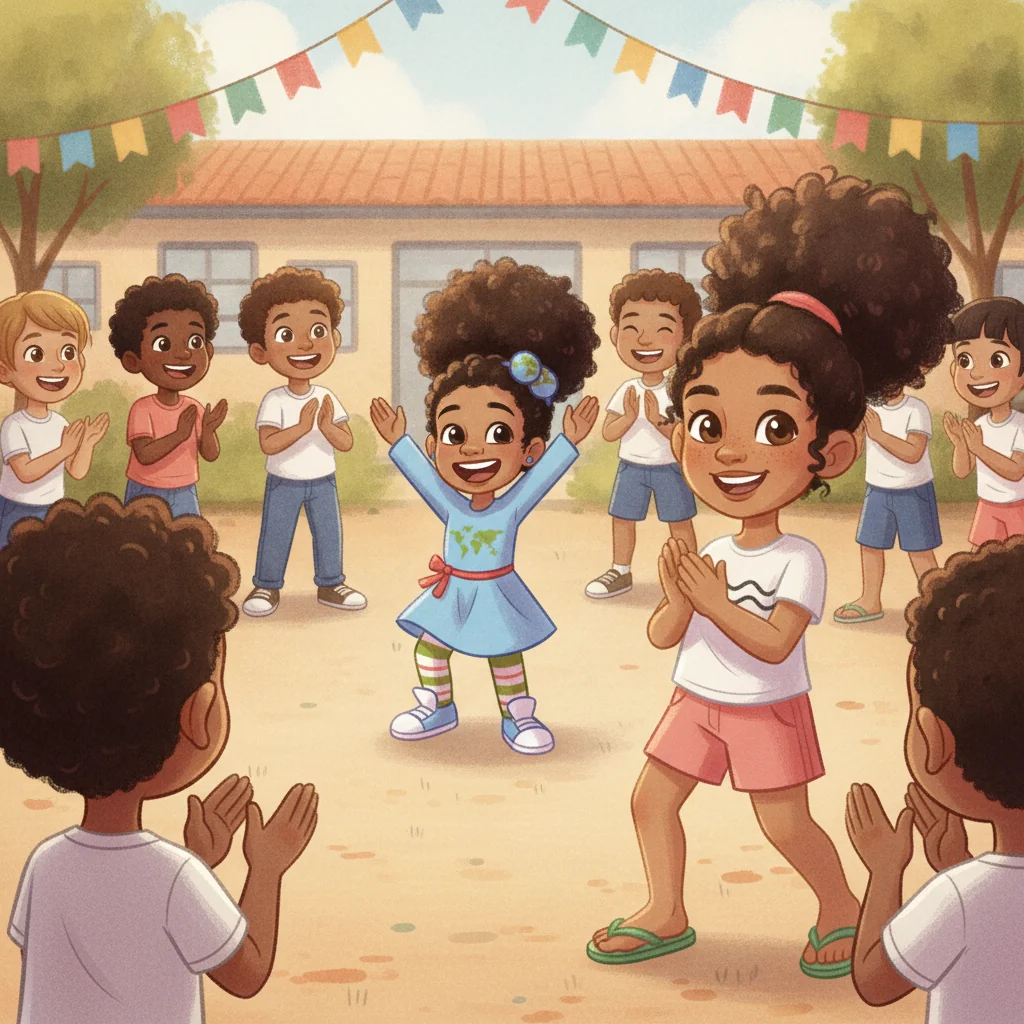
Alexandria welcomes you.

Rio de Janeiro, Brazil

Your turn.
Our circle.

I can make a gesture, give someone else a turn, and help our circle keep going.

Portuguese in Isabela’s story

A hello to start.

Listen, turn a card, and greet someone beside you.

Brazilian Portuguese

Oi!

Hi!

A friendly hello.

Brazilian Portuguese

Tudo bem?

How are you?

A way to ask how someone is doing.

Brazilian Portuguese

Obrigada.

Thank you.

Alexandria says obrigada in our story.

Brazilian Portuguese

Tchau!

Bye!

For the end of a visit.

Listen and notice

Many parts.
One piece of music.

Watch musicians playing with Rio composer Noca da Portela. Follow one person’s hands. What do they add while the others keep going?

A 15-second musical moment. Watch, listen, or explore the description below.

The sounds and pictures

A flute player moves his fingers along a flute. A seated drummer in a green shirt plays two hand drums. The camera opens to the group: each musician is making a different part at the same time. Noca da Portela stands near the middle holding a microphone, ready to sing. The flute melody rises and falls over a repeating percussion rhythm. This short excerpt has instrumental music, with no spoken words.

In our own circle, we will make our own gestures. Someone can take a turn while others help the circle continue.

Isabela’s school circle · Pages 12 and 13

There’s room for you.

Make a mark with your hand. Then make room for someone else. Your mark stays with our circle.

Draw, or tap for a dot. You can also use the arrows below. On a keyboard, focus the circle and use arrow keys or Space.

Turn 1

Your turn in the middle

Choose a place to join.

A small dot, a sweeping line, your own idea. There is no right shape.

Watching, pointing and helping a friend are ways to join, too.

Look what you made together.

Show someone one turn. Let them say what they notice before you tell your idea. Would you like to keep it, or try it another way?

In the book, Alexandria dances in the middle while Isabela and the other children hold the circle.
“Holding the edge is a job too.”
From our Rio story, page 13. Isabela makes room for Alexandria. Then Alexandria helps the next person have a turn.

Try it together

A circle in your room.

Gather with people you know. One person makes a small, safe gesture. A finger can swirl. A hand can wave. You can sit, stand or watch.

The others can echo the gesture if the maker wants, or notice it quietly. Make room for the next person. How will you help them feel welcome?

Try again. Change one thing that helps your group. These are your own gestures. You do not need to copy a dance.

Your passport

We’ve been to Rio.

Isabela makes room in her circle.
What will you bring to yours?

Our turns, together.

Take as long as you want. Add a voice, a gesture, or a quiet moment of noticing.

Make a new circle?

This clears the turns on this device. You can show your circle together first.

Explore together.

Start with the Rio book, pages 5, 12 and 13. This lesson works on a shared screen with a family or class. Younger children can tap, point or direct a partner. Older children can explain and revise a sequence.

Gather

Invite a small group. Read the moment where Isabela offers a turn, Alexandria makes her own dance and then returns to the edge to support the next child. The school scene is a particular fictional story. It is not a demonstration of every Rio school or a dance lesson.

Guide

Make one dot and use Make room once. Ask a child to show what changed. Then step back. A child can make a gesture at the center, add a supporting mark, help a friend or watch. No child has to perform, speak or touch another person.

Notice

The shared circle is the artifact. Each maker shows one intention by speaking, pointing or gesture. A partner describes what they see before the maker explains. Invite a change or a reason to keep the choice. Ask children to show where their mark went when they made room. There is no correct shape, beat or score.

Carry it into the room

Allow about 10–15 minutes for a small group's screen turns, then an optional 5–10 minutes of safe gestures together. Seated hand or finger movements are enough. Keep personal space and skip movements that hurt. Each child can choose whether others echo. Try a change that helps another person join, then notice its effect.

Why we learn this way

The child authors a gesture and can change it. The shared result preserves their contribution while opening room for the next person. Making, showing, listening and revising provide evidence of capability in a real social task.

Reflection and self-assessment happen in the conversation: what did I intend, what did someone notice, and what shall I keep or change? Transfer is the group's next safe circle or a small act of making room in everyday life.

History, evidence and perspective

A book illustration, a dated photograph and a musician's own account tell us different things. Ask who made each source, when and where, what we can observe, and what another account might add. A single person never stands for an entire city.

IPHAN, Brazil’s heritage institute, describes different Rio samba traditions and separately identifies jongo and capoeira. Our free gestures are our own. We do not teach them as samba, jongo or capoeira.

Tervalon and Murray-García’s cultural humility (1998) concerns reflection, power and accountable relationships in medical education. We apply those commitments here by listening to particular people and keeping cultural learning open. This is an educational adaptation, not a claim that the original study tested this lesson.

City photographs and sources

Five real, dated photographs show particular viewpoints. They are still images, not 360° recordings. We resized and compressed them for this page. The whole-photo view preserves each complete composition.

Licenses: CC BY-SA 4.0, CC BY-SA 2.0, CC BY 2.0 Brazil. Photo versions retain their original licenses.

Our five-second tram and road transitions are imagined views. They do not record a real trip or connect these places by a measured route. For a visit, an adult checks current transport and access.

Map data: OpenStreetMap contributors, ODbL; display: Leaflet.

Place information: Jardim Botânico’s own history, Museu do Amanhã, Riotur: Pequena África.

A real 360° museum visit, for grown-ups

The museum’s own Fruturos exhibition site offers a photographed 360° visit. It opens at Museu do Amanhã in Rio and leads into an exhibition about the Amazon, which is a different region. This outside provider includes its own controls and links. The lesson’s five photo stops remain available without loading it.

Museum’s original tour and accessible descriptions

Film source and rights

TV Brasil: Clássicos do samba e músicas da atualidade com Noca da Portela, published 4 July 2017. We use 00:47–01:02 of the broadcaster’s studio performance, featuring the instrumental opening of “Portela Querida.” The performer is Noca da Portela with accompanying musicians. This is a particular professional performance, not an instruction to copy a dance or a representation of every Rio community.

TV Brasil released the recording under CC BY 3.0. The Wikimedia Commons source and license review preserve the licensed copy. Changes: a 15-second excerpt, compression, an extracted poster and our separate English sound captions. The original audio is retained. Neither TV Brasil nor the musicians endorse this lesson.

Words to use together

These four listening models use a Brazilian Portuguese voice, Henrique Rodrigues. They say only the displayed phrases. They are pronunciation models, not Isabela’s voice or a testimony about Rio. A fluent speaker can help the group listen and respond naturally. Obrigada is the form Alexandria uses; obrigado is another form you may hear. No child must change or announce their identity to join a greeting.

Using this page

The circle and passport stay in this browser when storage is available. No name, voice or photograph is collected. New circle clears the displayed turns; Undo can restore the last change during this visit. If storage is unavailable, the activity still works for the current visit.

A real view of Rio

Our Rio places

The hillside, old port and Atlantic coast. Choose a stop to travel there.

Choose a place to keep exploring. These stops are not a travel itinerary.